How to Optimize Content for AI Search Engines: From Visibility Gap to Brief to Shipped Page
To optimize content for AI search engines, start from evidence, not a checklist. Find the buyer prompts where ChatGPT, Perplexity or Google's AI Overviews leave you out, note which sources they cite instead, write a brief that closes that gap, publish a clear, well-sourced page, then re-run the same prompts on a fixed schedule.
This guide shows how to optimize content for AI search engines by walking one example prompt cluster through all six steps. No step guarantees a mention: AI answers vary from run to run, and no engine publishes how it picks its sources.
- Find the prompts where you are absent
- Study the sources that win the answer
- Write an AI-search content brief
- Structure the page so claims are easy to verify
- Ship without blocking the crawlers you want
- Re-measure the same prompts on a schedule
What does optimizing content for AI search actually involve?
It is good SEO content with a new unit of measurement and a new starting point. You measure prompts, mentions and citations, and you start from a gap you saw in real answers.
Google's AI optimization guide, Optimizing your website for generative AI features on Google Search (last updated July 10, 2026), says foundational SEO still applies. Its mythbusting section says that for Google Search you can ignore llms.txt and other "special" markup, "chunking" content, rewriting content just for AI, seeking inauthentic mentions and overfocusing on structured data. It also warns that no third-party tool has access to Google's internal ranking or AI systems.
Microsoft comes at it from another side. In Optimizing Your Content for Inclusion in AI Search Answers (October 8, 2025), Krishna Madhavan of Microsoft Bing explains that Copilot parses pages into smaller pieces and builds answers from them. The post recommends clear headings, Q&A pairs, lists, tables, and a title, H1 and meta description that agree with each other.
Both reward well-organized pages written for people, and nothing in this guide is a ranking factor.

Step 1: Find the prompts where you are absent
Pick one cluster of buyer prompts, run each prompt several times on each engine, and log what comes back. Then sort the gap by type before you decide what to write.
Pick one prompt cluster tied to a page you can change
Start small: 5 to 8 prompts on one topic that a single page on your site could answer. In this guide's illustration, a made-up brand called Acme Payroll tracks prompts like these:
- "best payroll software for startups"
- "payroll software for a 10-person agency"
- "Competitor A alternatives for small teams"
- "is Acme Payroll legit"
Keep branded prompts (the last one) apart from non-branded ones, because they answer different questions. Pull ideas from sales calls, support tickets, Search Console queries and competitor comparisons. No AI engine publishes prompt volumes, so treat any tool's prompt "volume" as an estimate, not measured demand.
Run each prompt several times, per engine
For every run, record four things: whether the brand is mentioned, where it appears in the answer, how it is described, and every cited URL. Report a mention rate across runs and a position range, never a single screenshot.
Name each engine on its own: ChatGPT, Gemini, Perplexity, Claude, Microsoft Copilot, Google AI Overviews and Google AI Mode. They often disagree, so a gap on one is not a gap on all. Run each prompt 5 times per engine on the same day, from the same location and in the same login state, so you can see how much answers move on their own. That is 40 runs per engine for an 8-prompt cluster, so start with the two or three engines your buyers use most.
Classify the gap before you write anything
Not every gap is a content gap. Use this table to decide what work each gap needs.
| Gap type | What it looks like | Can a page on your site help? | Next step |
|---|---|---|---|
| 1. Absent while competitors are named | Competitor A and Competitor B appear and are cited; your brand does not | Yes | Create or expand a page that answers the prompt, and seek coverage on the sites that are cited |
| 2. Mentioned but described wrongly | The answer gives an old price, a missing feature or the wrong audience | Partly | Treat it as a correction job, not a new page: see how to correct wrong brand information in AI answers |
| 3. Mentioned, but other sites are cited | Your brand is named, but the sources are review sites and a rival's blog | Yes, in part | Improve the page that should be cited, or get your brand onto the pages that are cited |
| 4. No citations at all | The answer cites nothing and seems to come from the model's training data | Not soon | On-site changes may not move it until the model is updated; log it and work elsewhere first |
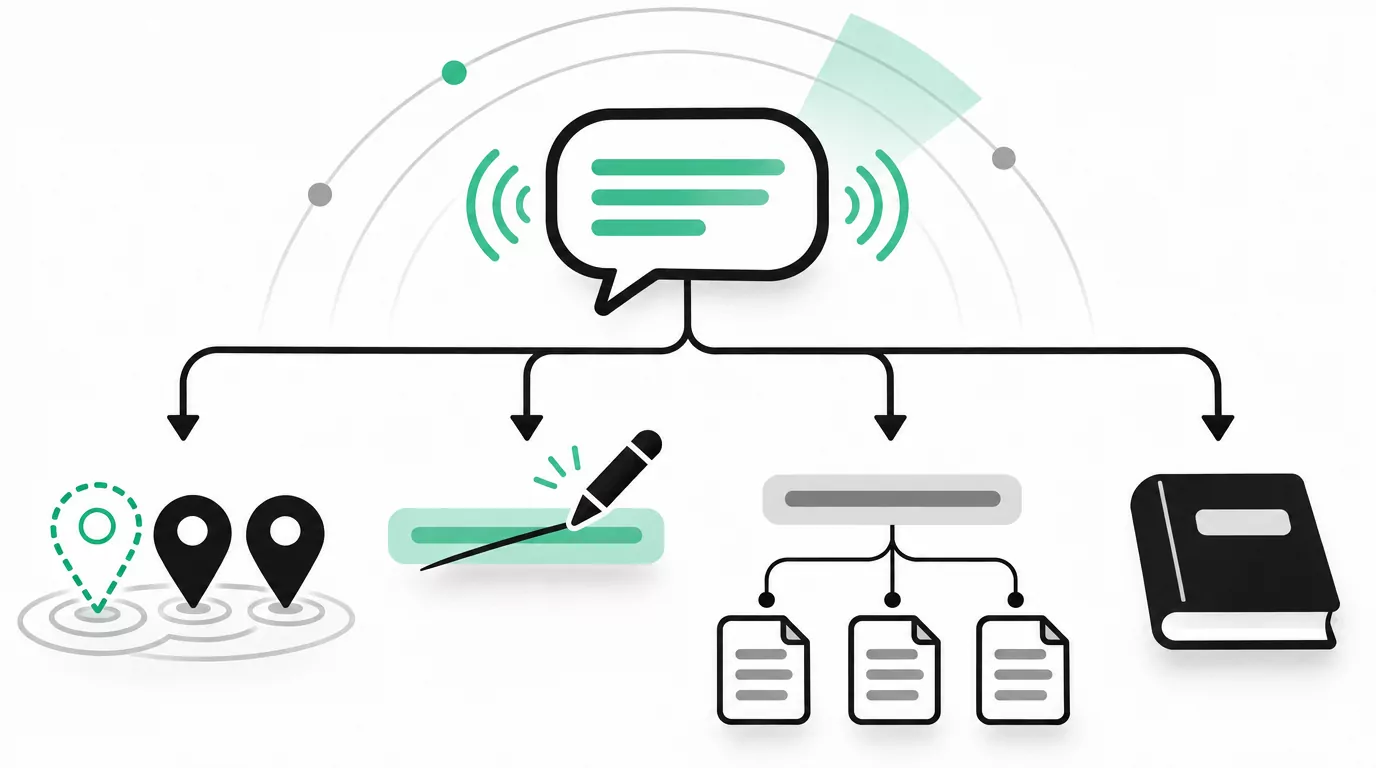
Step 2: Study the sources that win the answer
Open every URL the answers cited and note what each one gave the engine. For each page, log the source type (brand site, publisher, review site, forum, video), the exact claim the answer took, the page format, the visible date and whether your brand appears there. Three made-up rows from the Acme Payroll illustration show the idea.
| Cited URL (illustration) | Source type | Claim the answer used | Format | Date shown | Acme on the page? |
|---|---|---|---|---|---|
| review.example/best-payroll-startups | Review site | "Competitor A suits teams under 20" | Comparison table | March 2026 | No |
| example.com/blog/payroll-costs | Rival blog | A monthly price range for payroll tools | Pricing explainer | June 2026 | No |
| example.org/forum/contractor-payroll | Forum | "Competitor B handles contractors well" | Discussion thread | August 2026 | Yes, one reply |
Then split the gap in two. The on-site part is a question a page you own should answer, such as team size or contractor support. The off-site part lives on third-party lists and review pages that cite competitors.
Do not try to close the off-site part by seeding forums or buying mentions. Google's guide says seeking inauthentic mentions "isn't as helpful as it might seem." Update your own listings on the cited review sites, and pitch real facts to the authors who cover the topic.
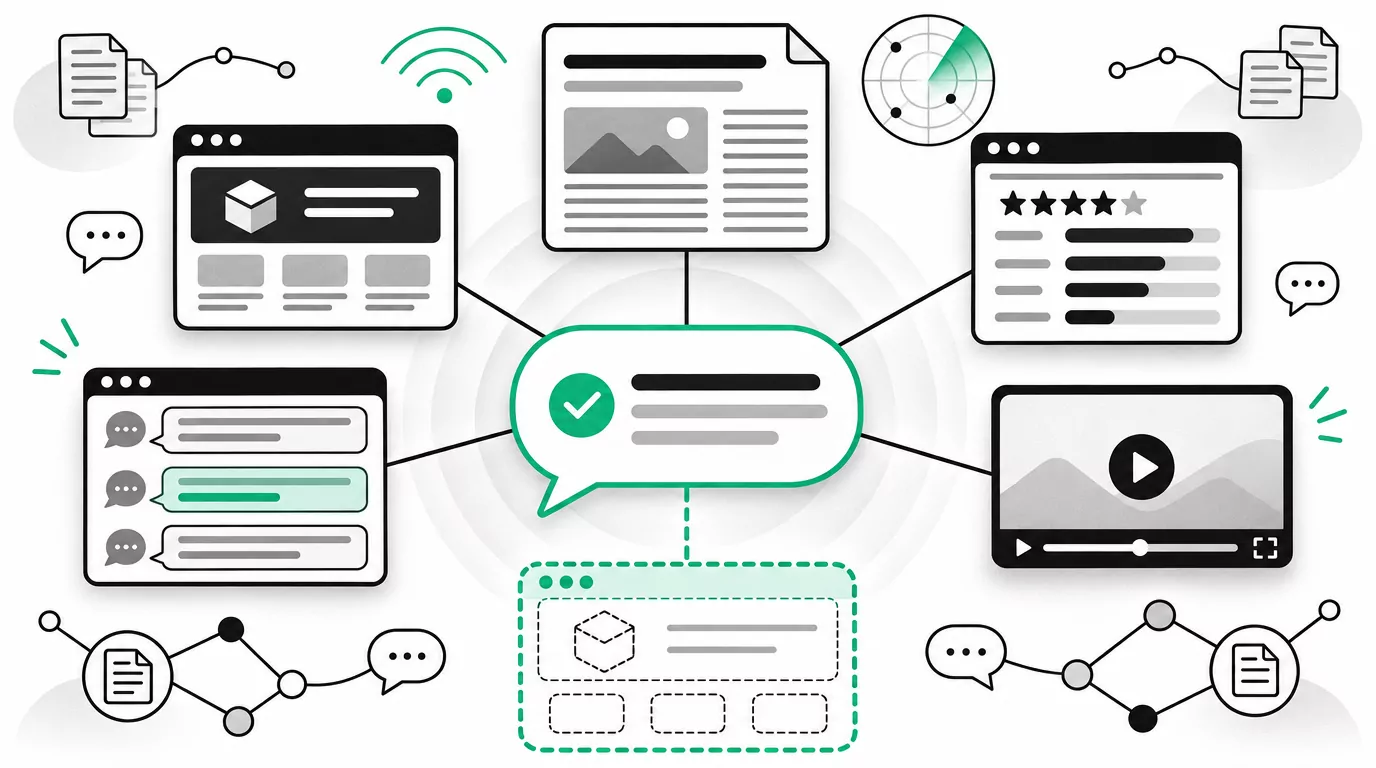
Step 3: Write an AI-search content brief (template)
A brief for AI search records the evidence first: the prompts, the baseline from an AI visibility audit, who wins and why. Then it says what the page must state plainly and how you will check the result.
Use this ten-field content brief template. The last column fills it in for Acme Payroll, and every number there is made up.
| Field | What to write | Acme Payroll example (illustration) |
|---|---|---|
| 1. Prompt cluster | 3 to 10 prompts, each tagged branded or non-branded | Five non-branded prompts on payroll for small teams, one branded |
| 2. Baseline per engine | Mention rate across N runs, position range, date, location and language | Perplexity: named in 2 of 5 runs, 4th and 6th; ChatGPT: 0 of 5; US, English, November 3 |
| 3. Competitors named | In the order they appear | Competitor A, Competitor B, then Acme Payroll |
| 4. Sources cited | URL, source type and the claim used | review.example comparison table (team size claim); example.com pricing explainer |
| 5. Gap statement | One sentence, plus the gap type from Step 1 | "Answers suggest rivals for small teams because no Acme page states team size, setup time or contractor support." Type 1. |
| 6. Page to create or update | URL, and why this page rather than another | /payroll-for-small-teams, because it already ranks for the topic and can hold a comparison |
| 7. Answer-first summary | The 2 to 3 sentences the page must state plainly | "Acme Payroll is payroll software for US teams of 2 to 50. It pays staff and contractors in one run." |
| 8. Facts, entities and evidence | Product name, category, audience, integrations, locations, and only real evidence | Supported states, accounting integrations, a setup-time test with its method, input from a named payroll specialist |
| 9. Off-site actions (optional) | Cited publishers or review profiles to update or pitch | Update the review.example profile; send the facts to the comparison's author |
| 10. Checks, dates and owner | Pre-ship checks, re-measure dates, owner and ship date | Step 5 checks; re-measure 2, 4 and 8 weeks after indexing; owner: content lead; ship November 20 |
Copy the table into your own doc and fill in one brief per prompt cluster. If a field stays empty, such as no real evidence for field 8, solve that before anyone starts writing.
Plan one page per cluster, not one per prompt. Google's guide warns that making separate content for every way people might search, mainly to manipulate rankings or its AI responses, violates its scaled content abuse policy.
Step 4: Structure the page so its claims are easy to find and verify
Write the page so a reader, or an engine, can find each claim and check it. This is documented hygiene that matches what Google and Microsoft publish. It is not a ranking-factor list, and it promises nothing.
Lead with the answer
Put 2 to 3 sentences of direct answer under the title and under each question-style H2. Microsoft says assistants can often lift Q&A pairs word for word into answers. Keep the page whole, not a pile of loose snippets.
Make entities unambiguous
Name the product, the category, the audience and the alternatives in plain words. Use the same names in the title, H1, meta description and body. Avoid key sentences whose only subject is a pronoun, such as "It integrates with..."
Before (illustration): "The platform makes it simple to pay everyone. It works with the tools you already use, and setup is fast."
After (illustration): "Acme Payroll is payroll software for US teams of 2 to 50 people. It pays employees and contractors in one run and connects to QuickBooks Online and Xero. In Acme's published setup test (method linked), a 12-person team finished setup in one working day."
Source every claim and name the author
Link primary sources, date every number and describe the method behind any test. Use a table only where the content is a comparison. Google's guidance on helpful, people-first content and its call for "non-commodity" content point the same way: add first-hand data and experience, not a rewrite of what already ranks.
Show who stands behind the page, too. That same guidance strongly encourages accurate bylines where readers expect them, and asks whether each byline leads to background on the author. It calls fabricated author profiles, such as made-up names or false credentials, a form of deception.
Treat schema and llms.txt as hygiene
Google says structured data isn't required for generative AI search and there is no special schema.org markup to add, though it still helps with rich results. Google Search ignores llms.txt, so it neither helps nor harms there; keep valid markup that matches what is visible on the page.
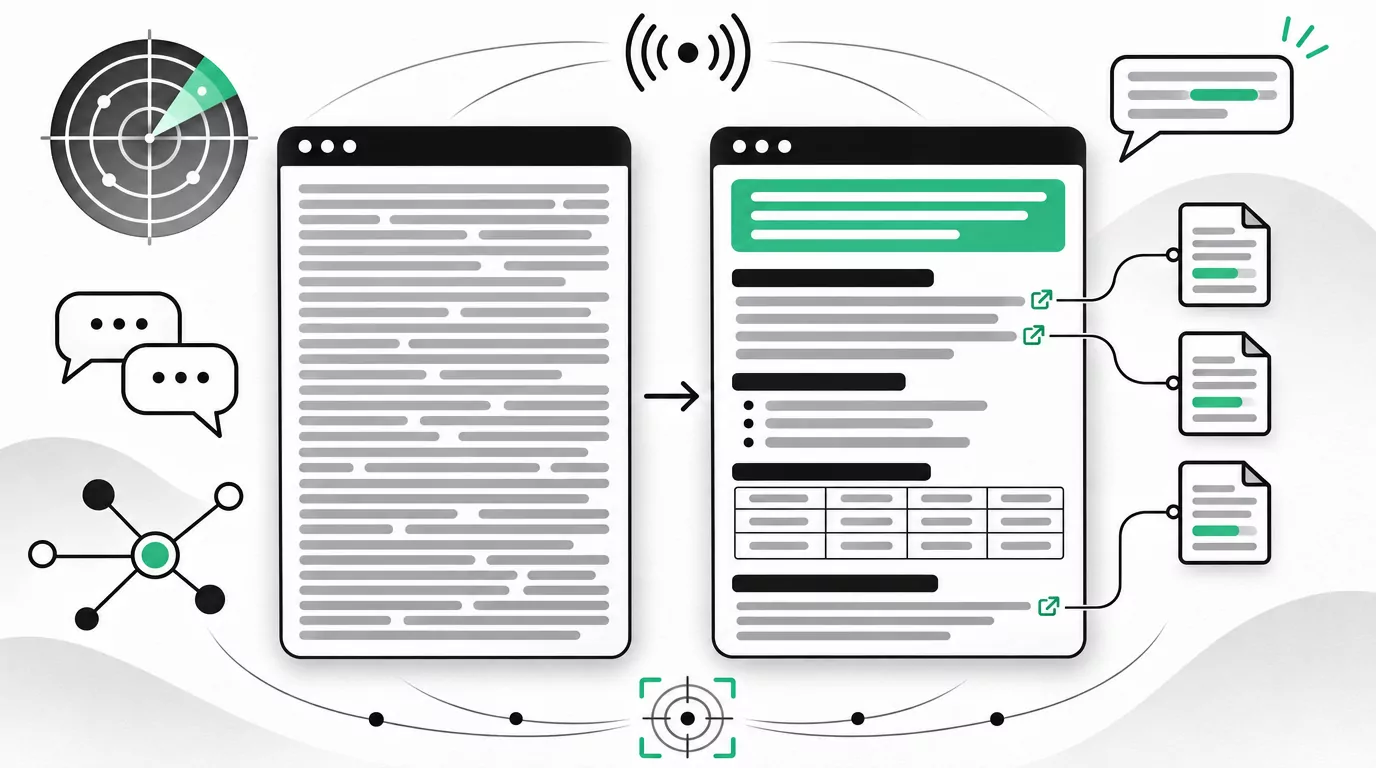
Step 5: Ship it without blocking the crawlers you want
Before you publish, confirm that the crawlers you want can reach and index the page. Five checks cover it.
- The page returns 200, is indexable, is canonical to itself and is in your XML sitemap. Google says a page must be indexed and eligible to show with a snippet under its Search technical requirements, and the site must be included in Search generative AI features in Search Console (include is the default).
-
robots.txtallows the search crawlers you want:Googlebot,Bingbot,OAI-SearchBot,PerplexityBotandClaude-SearchBot. Training crawlers (GPTBot,ClaudeBot) are a separate choice.Google-Extendedis arobots.txttoken, not a crawler: Google says it does not affect Google Search, but blocking it also keeps your pages out of grounding in Gemini Apps. OpenAI says sites opted out ofOAI-SearchBotare not shown in ChatGPT search answers, and arobots.txtchange can take about 24 hours to apply. - Your CDN or bot manager (for example Cloudflare AI Crawl Control) is not blocking crawlers that
robots.txtallows. - The main content is in the HTML response itself.
- Request indexing with URL Inspection in Search Console, and submit the URL in Bing Webmaster Tools or through IndexNow.
Step 6: Decide what to re-measure, and when
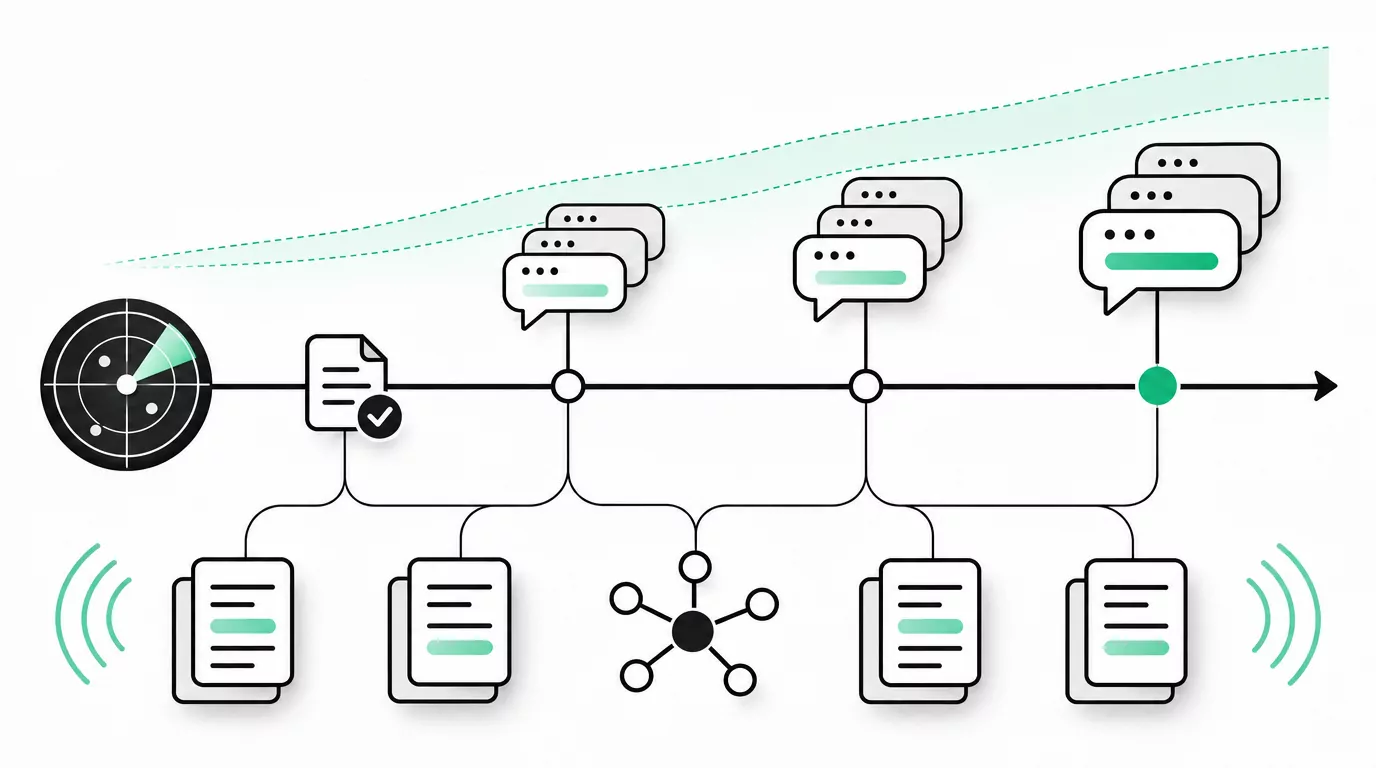
Re-run the exact prompts from your brief, with the same engines, number of runs, location and language. Start the clock when the page is indexed, not when you hit publish.
URL Inspection shows when Google has indexed the page. From there, plan re-checks at 2, 4 and 8 weeks. That is a planning habit, not a documented timeline.
Answers that search the web, such as ChatGPT search, Perplexity and AI Overviews, can pick up a newly indexed page. Answers drawn from a model's training data are unlikely to change until that model is updated, and no engine documents when that happens.
| Metric | Where to read it | What counts as a real change | Caveat |
|---|---|---|---|
| Mention rate and position range across runs | Your prompt log | A shift larger than the run-to-run spread you saw at baseline | Answers vary by run, location and login state |
| Your URL among cited sources | Your prompt log | The page is cited on more runs than at baseline | A citation is not a click |
| Description accuracy | Your prompt log | The answer now states the facts from the brief | Wrong descriptions go to the correction workflow |
| AI Overviews and AI Mode impressions for the page | Search Console Generative AI performance report (all sites since August 31, 2026) | A steady rise after indexing | Google only, and impressions only |
| Copilot and Bing AI citations | Bing Webmaster Tools AI Performance (public preview since February 10, 2026) | The page shows page-level citations | Grounding queries are a sample |
| AI-referred sessions | GA4 | Directional movement only | Correlation, not attribution; see how to track AI traffic in GA4 for the channel setup and both reports above |
If nothing moved after 8 weeks, go back to the brief. Re-check the gap type, who is still cited and why, and whether the page is indexed at all. Never "refresh" a page by changing its date alone.
MentionForce is built for the tracking side of this loop: where AI answers mention your brand, how you compare with competitors, and which sources those answers cite. Follow MentionForce updates on the blog.
Frequently Asked Questions
How long does it take for content changes to show up in AI answers?
No engine documents a timeline, so plan re-checks from the date the page is indexed (Step 6). OpenAI's 24-hour note covers robots.txt changes in ChatGPT search, not how fast new content is picked up.
Do you need to write content differently for AI search?
No. Google says you don't need to write in a special way or chunk content for its generative AI features. Clear, answer-first, well-sourced pages serve readers and every engine.
Does schema markup or llms.txt help content appear in AI answers?
Treat both as hygiene, not levers. Google says no special schema is needed for its AI features and that Google Search ignores llms.txt. Keep valid structured data for rich results.
Is optimizing for AEO or GEO different from SEO?
GEO (generative engine optimization), AEO (answer engine optimization) and LLM SEO are interchangeable labels for the same work. It overlaps heavily with SEO; the main difference is that you also measure prompts, mentions and citations.
How do you rank or appear in AI search results?
There is no fixed position to rank for in an AI answer. Track how often and where you are mentioned across repeated runs, and close gaps one prompt cluster at a time, starting with Step 1 and checking with Step 6.
How to optimize content for AI search engines, one cluster at a time
The loop is short: find the gap, study the sources, write the brief, ship a clear page, then re-measure the same prompts. Pick one prompt cluster this week and run it through Step 1 before anyone writes a word.